How Do You Do Percentages Off ? 3 Easy Methods
Admin · November 12, 2026 · Last updated November 12, 2026 · 6 min read
How Do You Do Percentages Off?
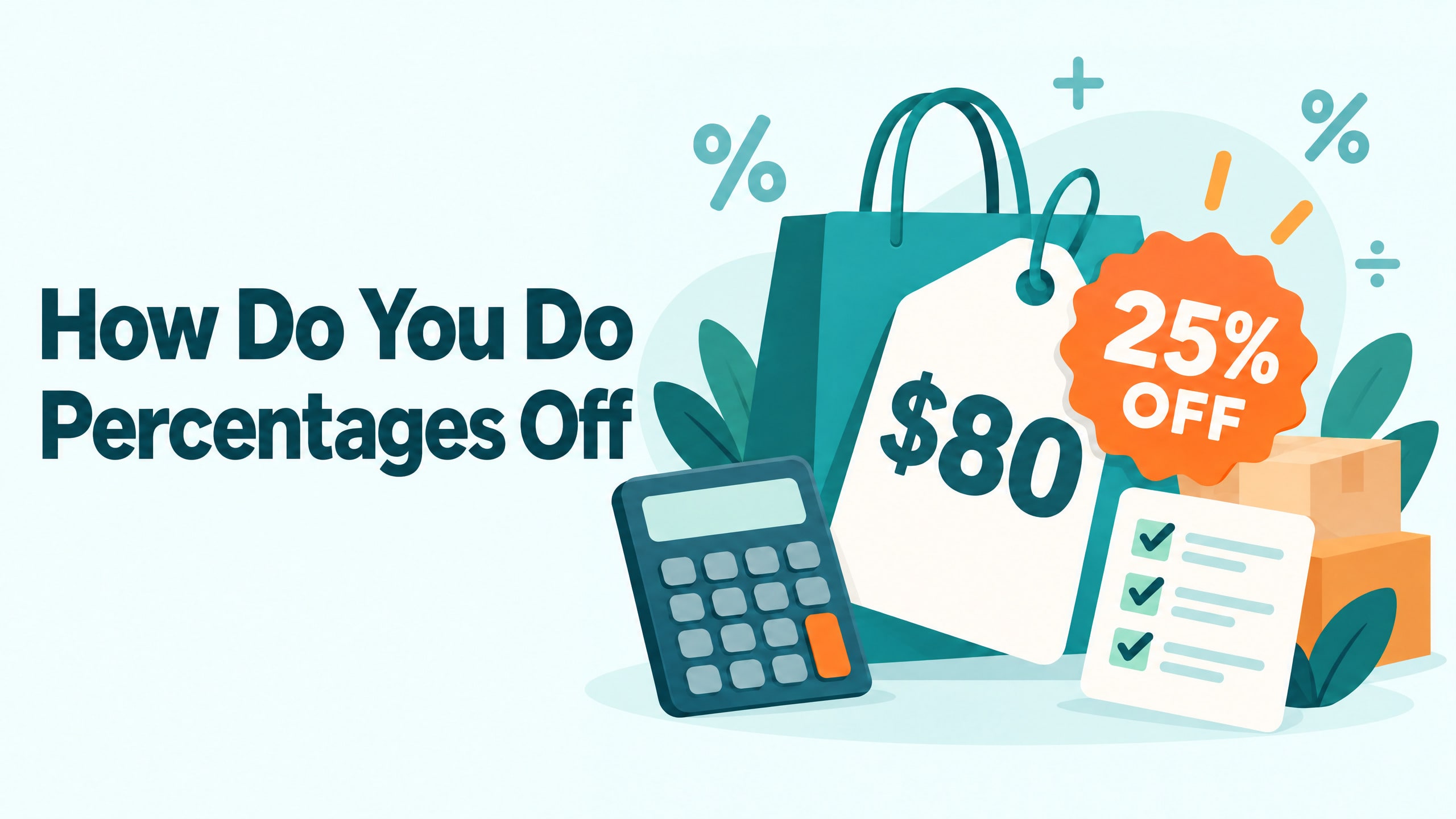
How do you do percentages off? Convert the percent to a decimal, multiply it by the price, then subtract that amount from the original price. For example, 25% off $80 is 0.25 × 80 = $20 off, so you pay $60. That's the whole trick. Below you'll find faster shortcuts, plus how to handle stacked discounts and BOGO deals. If you just want the answer, use our Discount Calculator.
The quick answer: 3 steps
Turn the percent into a decimal. Divide by 100: 25% becomes 0.25.
Multiply by the original price. 0.25 × $80 = $20. That's your savings.
Subtract the savings from the price. $80 − $20 = $60.
Formula: Sale price = Original price × (1 − discount %)
Check it: $80 × (1 − 0.25) = $80 × 0.75 = $60. Same answer, one step.
Method 1: the decimal method
This is the most reliable way to calculate a percent off, and it works for any price and any discount.
Example 1: $120 at 30% off
30% = 0.30
0.30 × $120 = $36 off
$120 − $36 = $84
Example 2: $45.99 at 15% off
15% = 0.15
0.15 × $45.99 = $6.8985, which rounds to $6.90 off
$45.99 − $6.90 = $39.09
Tip: round only at the end. Rounding too early can leave you a cent off.
Method 2: the "pay what's left" shortcut
Instead of working out the discount and subtracting it, work out what you still pay. If something is 30% off, you pay the other 70%.
30% off → pay 70% → multiply by 0.70
25% off → pay 75% → multiply by 0.75
15% off → pay 85% → multiply by 0.85
Example: $65 at 30% off. $65 × 0.70 = $45.50. One multiplication, no subtraction.
Want every variation, including odd percentages and prices with cents? See our full guide: how to calculate percent off any price.
Method 3: mental math tricks
You can work out most sales in your head. Here are the shortcuts, using a $64 item.
10% off: move the decimal one place left. 10% of $64 is $6.40, so you pay $57.60.
20% off: find 10% and double it. $6.40 × 2 = $12.80 off, so you pay $51.20.
25% off: take a quarter. $64 ÷ 4 = $16 off, so you pay $48.
30% off: find 10% and triple it. $6.40 × 3 = $19.20 off, so you pay $44.80.
50% off: cut it in half. You pay $32.
For 15%, add 10% and half of 10%. On $64 that's $6.40 + $3.20 = $9.60 off.
Half-price deals come up constantly, so we gave them their own page: 50% off.
Quick reference table: common discounts on a $100 item
Discount | You save | Sale price |
|---|---|---|
10% off | $10 | $90 |
15% off | $15 | $85 |
20% off | $20 | $80 |
25% off | $25 | $75 |
30% off | $30 | $70 |
40% off | $40 | $60 |
50% off | $50 | $50 |
On a $100 item the savings equal the percentage. For other prices, scale it: 20% off a $250 item is 2.5 × $20 = $50 off.
How do you do percentages off when there are two discounts?
A store offers 20% off, and you also have a 10% coupon. Is that 30% off? No. The second discount applies to the already-reduced price, not the original.
Worked example on a $100 item:
Take 20% off: $100 × 0.80 = $80
Take 10% off the new price: $80 × 0.90 = $72
You saved $28, which is 28% off, not 30%. The shortcut: multiply the "pay what's left" decimals together. 0.80 × 0.90 = 0.72, so you pay 72% of the original price.
How to find the original price from the sale price
Seen a sale price and want to know what it cost before? Divide by what's left after the discount.
Original price = Sale price ÷ (1 − discount %)
Example: a jacket is $60 after 25% off. $60 ÷ 0.75 = $80 originally.
A common mistake here is adding 25% to $60 (which gives $75). That's wrong, because the 25% was taken from the original price, not from $60.
How much is it really? BOGO and "buy 2 get 1 free" as a percentage
Free-item deals are discounts in disguise. Turn them into a percentage to compare them with a straight sale.
Buy one, get one free (BOGO): you pay for 1 of 2 items, so it's 50% off the total.
Buy 2, get 1 free: you pay for 2 of 3 items, so you save 1 in 3, or about 33% off. With $20 items you pay $40 for three, about $13.33 each.
Buy one, get one 50% off: you save half the price of one of two items, so it's 25% off the total.
So a 40% off sale beats "buy 2 get 1 free" if you'd buy three items anyway.
Percentages off in Excel
Spreadsheets make repeat calculations easy. Put the original price in cell A2 and the discount (formatted as a percentage, like 25%) in B2.
Sale price:
=A2*(1-B2)Amount saved:
=A2*B2Original price from a sale price:
=A2/(1-B2)
Fill the formula down the column and you can price a whole list in seconds. Don't want to build it yourself? Download our free Discount Calculator Template for Excel.
Common mistakes
Adding discounts together. 20% off plus 10% off is 28%, not 30%. Apply them one after another.
Applying the percent to the wrong number. Take the percent of the original price, then subtract. Don't take it of the sale price, and don't add it to the sale price when working backward.
Forgetting tax order. Sales tax or VAT is usually added after the discount, so the discount lowers the taxable amount. Example: $80 at 25% off is $60, and 8% tax on $60 is $4.80, for $64.80 total. Check your receipt, because coupon rules vary by store.
FAQ
How do you take 20% off a price?
Multiply the price by 0.80. For a $50 item, $50 × 0.80 = $40. Or find 10% ($5), double it ($10), and subtract: $50 − $10 = $40.
How do you do percentages off without a calculator?
Start with 10% by moving the decimal one place left, then build from there. Double it for 20%, triple it for 30%, halve it for 5%. For 25%, divide by 4. For 50%, divide by 2.
What is 15% off $50?
10% of $50 is $5 and 5% is $2.50, so 15% is $7.50. You pay $50 − $7.50 = $42.50.
Is 20% off plus 10% off the same as 30% off?
No. The two discounts apply one after the other, so 20% then 10% works out to 28% off in total. On a $100 item you pay $72, not $70.
How do I calculate percentage off in Excel?
With the price in A2 and the discount in B2, enter =A2*(1-B2) for the sale price. Use =A2*B2 to see how much you saved.
Conclusion
To do percentages off, convert the percent to a decimal, multiply by the price, and subtract. Or skip a step and multiply by what's left: 0.75 for 25% off, 0.70 for 30% off. For stacked discounts, multiply the "what's left" decimals together.
Need an answer right now? Try the Discount Calculator. Pricing lots of items or checking deals regularly? Grab the free Excel Discount Calculator Template and reuse it every time.