Practical guide
How to calculate percent off any price (3 simple methods)
Learn how to calculate percent off a price in one step, master the percent off formula with worked numbers, and use the built-in calculator plus a reference table to check any tag in seconds.
- 3 proven methods
- Worked examples
- Free calculator
By Fileforia Editorial Team · Last updated: Oct 17, 2026
Quick answer: how to calculate percent off
To calculate percent off, multiply the original price by the percentage divided by 100; the result is the money you save. Subtract that amount from the original price to get the sale price. Example: 30% off $50 is 50 × 0.30 = $15 saved, so you pay $35. That one line is how to calculate percent off of a price you see in a shop or online, and how to calculate percentage discount for any currency, in one attempt, without a second guess.
What to remember about percent off
- The formula fits on one line: original price × percentage ÷ 100 gives the savings, and original price − savings gives the price you pay.
- Keep the pay factor in mind: paying 70% of a price means 30% off, and the factor 0.70 works on any amount without exception, in any currency.
- Between two prices the method stays the same: divide the gap by the higher price, multiply by 100, and you know the real discount that offer gives.
- Two discounts stack by multiplying: 20% then 10% is 28% total, not 30%, because the second one hits a price the first already reduced.
- The calculator on this page verifies every result in seconds, so you never have to memorize a formula or reach for a pocket calculator at the till.
How to calculate percent off: 3 simple methods
Method 1: the percent off formula to memorize
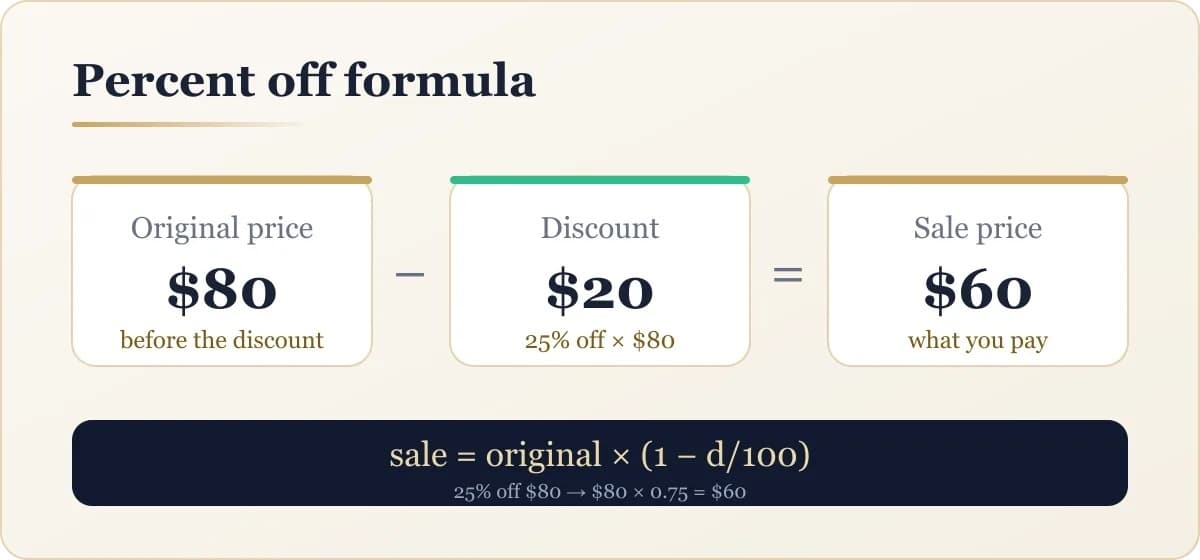
savings = price × d/100 ; sale = price − savings30% off $50 → 50 × 0.30 = $15 → pay $35
Method 2: one single step
sale = price × (1 − d)50 × (1 − 0.30) = $35 to pay at the till
Method 3: mental math shortcuts
find 10% then scale (20% = 2 × 10%, 25% = a quarter, 15% = 10% + 5%)25% off $80: 10% = $8, a quarter = $20
How do you find percent off?
Subtract the sale price from the original price, divide that gap by the original price, then multiply by 100. With $120 and $90, the gap is 30, then 30 / 120 = 0.25, and 0.25 × 100 gives 25% off the higher price. That is exactly how to find discount percentage between two prices without guessing.
How do you take a percentage off a number?
Turn the percentage into a decimal, multiply the number by that decimal to get the amount to remove, then subtract it from the starting number. Taking 15% off 240 means 0.15 × 240 = 36, so you remove 36 and keep 204. This is the fastest way to take a percentage off a number at the till.
How do I work out a discount percentage?
Divide the sale price by the original price and multiply by 100 to see what share of the price you still pay; the rest is the discount percentage. An $80 item sold for $60 gives 60 / 80 = 0.75, or 75% of the original, so the discount percentage is 25% on that offer.
How do you figure out percent off?
Pick the larger of the two prices as the reference, work out the difference, divide it by that original price, then multiply by 100. Between $150 and $105 the gap is 45, 45 / 150 = 0.30, so the product moved from $150 to $105 — that is 30% off in real money, not a rounded guess on the shelf.
How to calculate percentage in discount?
Always relate the saving back to the starting price: divide the saving by the original price, then multiply by 100. If you save $20 on an $80 item, 20 / 80 = 0.25, a 25% discount you can compare against every other offer. The percentage definition on Wikipedia uses exactly this ratio.
Reverse the formula to find the original price
Divide the sale price by 1 minus the discount rate. After 30% off, an item shown at $35 is 35 / 0.70, which is $50. The check is instant: 50 × 0.70 = $35. This trick matters during sales, when only the reduced sticker is visible and you want the pre-promotion price to compare two shops — or to confirm the store did not raise the tag before cutting it. Try a second rate as a sanity check: if the same $35 tag had carried 50% off instead, the original would be 35 / 0.50 = $70, a very different product tier.
Stack two discounts the right way
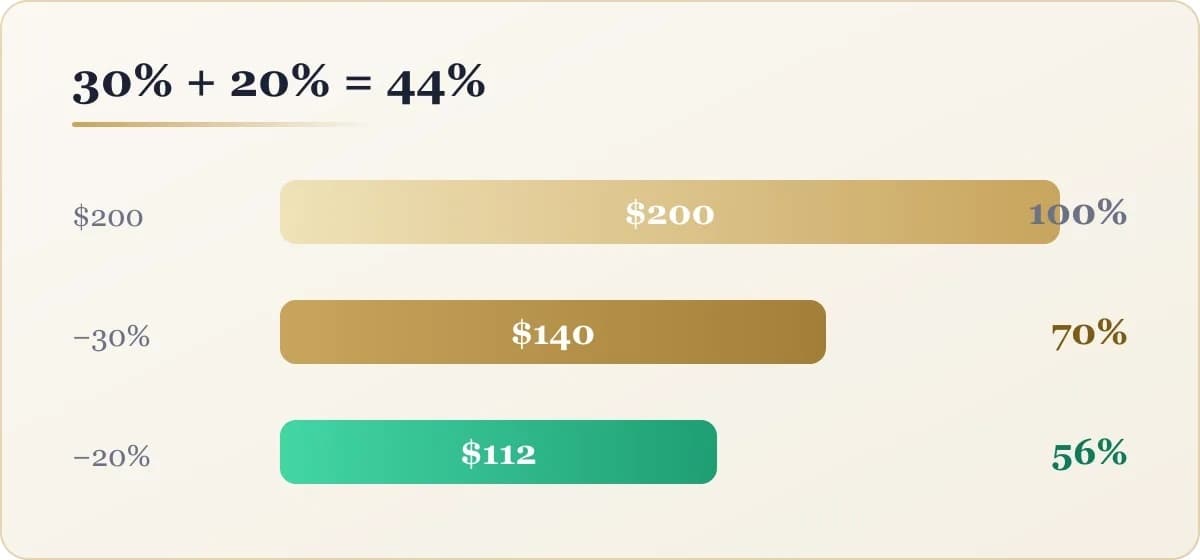
Two discounts do not add, they multiply. On $200, first 20% then 10%: 200 × 0.8 = $160, then 160 × 0.9 = $144. You save $56, which is 28% in total — not 30%. To calculate a stacked deal without a mental slip, run the numbers in the free discount calculator, then remember the rule: every new discount strikes the already-reduced price, never the original one. The same multiplication applies to three or more offers, which is why a final clearance on top of a member rate can still disappoint once you do the real math.
How to calculate percent off in Excel and Google Sheets
Here is how to calculate percent off in Excel and Google Sheets with no fiddly formula: type the price in B2 and the rate in C2, then let the sheet return the sale price in one line, with no manual rounding and no double entry, even on a long weekly shopping list. The same two cells also feed a savings column, so the spreadsheet shows both the price you pay and the money you keep.
=B2*(1-C2)The line multiplies the price by 1 minus the rate: B2 holds the price, C2 the rate as a decimal such as 0.30 for 30% off. Drag the formula down the column to process every price at once, then add a second column with =B2-C3 style checks if you want the savings visible next to each sale price.
Percent off mental math: 4 handy tricks
Percent off mental math rests on a few easy anchors. For 10%, slide the decimal: 10% of 240 is 24. For 20%, double that result; for 25%, take a quarter; for 15%, add 10% plus half of that 10%. Worked example: on $80 with 15% off you find 8 + 4 = $12 saved, so you pay $68. Keep the pay factor too: 30% off means paying 70%, and 70% of $200 is $140. These reflexes are enough to check a shelf label and know instantly whether the offer is honest, before your phone even leaves your pocket. The Khan Academy lesson on taking a percent off drills the same reasoning with guided practice, and discounts and allowances covers how shops apply them in catalogues and clearance events.
Common percent off mistakes
Adding two discounts instead of multiplying
20% then 10% gives 28% in sequence, never 30%, because the second discount lands on a price the first already cut.
Applying tax before the discount
The discount applies to the pre-tax price, then tax follows the reduced amount; reversing the order inflates the total at the register.
Rounding too early
Round only the final figure, otherwise tiny errors pile up and the screen price no longer matches the number on the tag.
Mixing up "X% of" with "X% off"
20% of $50 is $10 taken away from a different base, while 20% off $50 leaves exactly $40 to pay — a different number every time.
Reference table for percent off
| Discount | Pay this factor |
|---|---|
| 10% off | 0.90 |
| 15% off | 0.85 |
| 20% off | 0.80 |
| 25% off | 0.75 |
| 30% off | 0.70 |
| 35% off | 0.65 |
| 40% off | 0.60 |
| 45% off | 0.55 |
| 50% off | 0.50 |
| 55% off | 0.45 |
| 60% off | 0.40 |
5 solved percent off examples, easiest first
10% off $50
50 × 0.10 = $5 saved, so you pay $45 at the register, in one line.
20% off $120
120 × 0.80 = $96, saving $24 on the purchase in one step.
25% off $80
A quarter of 80 is $20, so the sale price is exactly $60.
35% off $340
340 × 0.65 = $221, which is $119 off a larger planned purchase.
20% then 10% off $200
200 × 0.8 × 0.9 = $144, saving $56 and 28% in total.
FAQ: how to calculate percent off without errors
What is the fastest percent off formula?
How do I take 30% off $80?
Is a crossed-out price always honest?
Can I add two stacked discounts?
Does tax apply before or after percent off?
How do I check a percent off calculation at the till?
Keep learning about discounts
Free discount calculator
The main tool for checking any price in one click, with no sign-up and full privacy in your browser, on desktop or phone.
50 percent off explained
What half price really means on any product, plus stacked offers and tax on a 50% discount.
Discount cheat sheet
Printable formulas and mental math shortcuts to keep in your wallet or phone case.
Popular questions about percent off
The most asked questions about how to calculate percent off a price, recovering the original tag after a promotion, or comparing two offers on a shop window this week — with plain numbers.
10% off
| Question | You pay | You save |
|---|---|---|
| What is 10% off $15.00? | $13.50 | $1.50 |
| $20.00 with 10% off | $18.00 | $2.00 |
| What is 10% off $25.00? | $22.50 | $2.50 |
| $30.00 with 10% off | $27.00 | $3.00 |
| What is 10% off $40.00? | $36.00 | $4.00 |
| $50.00 with 10% off | $45.00 | $5.00 |
| What is 10% off $60.00? | $54.00 | $6.00 |
| $70.00 with 10% off | $63.00 | $7.00 |
| What is 10% off $80.00? | $72.00 | $8.00 |
| $100.00 with 10% off | $90.00 | $10.00 |
| What is 10% off $150.00? | $135.00 | $15.00 |
| $200.00 with 10% off | $180.00 | $20.00 |
15% off
| Question | You pay | You save |
|---|---|---|
| What is 15% off $15.00? | $12.75 | $2.25 |
| $20.00 with 15% off | $17.00 | $3.00 |
| What is 15% off $25.00? | $21.25 | $3.75 |
| $30.00 with 15% off | $25.50 | $4.50 |
| What is 15% off $40.00? | $34.00 | $6.00 |
| $50.00 with 15% off | $42.50 | $7.50 |
| What is 15% off $60.00? | $51.00 | $9.00 |
| $70.00 with 15% off | $59.50 | $10.50 |
| What is 15% off $80.00? | $68.00 | $12.00 |
| $100.00 with 15% off | $85.00 | $15.00 |
| What is 15% off $150.00? | $127.50 | $22.50 |
| $200.00 with 15% off | $170.00 | $30.00 |
20% off
| Question | You pay | You save |
|---|---|---|
| What is 20% off $15.00? | $12.00 | $3.00 |
| $20.00 with 20% off | $16.00 | $4.00 |
| What is 20% off $25.00? | $20.00 | $5.00 |
| $30.00 with 20% off | $24.00 | $6.00 |
| What is 20% off $40.00? | $32.00 | $8.00 |
| $50.00 with 20% off | $40.00 | $10.00 |
| What is 20% off $60.00? | $48.00 | $12.00 |
| $70.00 with 20% off | $56.00 | $14.00 |
| What is 20% off $80.00? | $64.00 | $16.00 |
| $100.00 with 20% off | $80.00 | $20.00 |
| What is 20% off $150.00? | $120.00 | $30.00 |
| $200.00 with 20% off | $160.00 | $40.00 |
25% off
| Question | You pay | You save |
|---|---|---|
| What is 25% off $15.00? | $11.25 | $3.75 |
| $20.00 with 25% off | $15.00 | $5.00 |
| What is 25% off $25.00? | $18.75 | $6.25 |
| $30.00 with 25% off | $22.50 | $7.50 |
| What is 25% off $40.00? | $30.00 | $10.00 |
| $50.00 with 25% off | $37.50 | $12.50 |
| What is 25% off $60.00? | $45.00 | $15.00 |
| $70.00 with 25% off | $52.50 | $17.50 |
| What is 25% off $80.00? | $60.00 | $20.00 |
| $100.00 with 25% off | $75.00 | $25.00 |
| What is 25% off $150.00? | $112.50 | $37.50 |
| $200.00 with 25% off | $150.00 | $50.00 |
30% off
| Question | You pay | You save |
|---|---|---|
| What is 30% off $15.00? | $10.50 | $4.50 |
| $20.00 with 30% off | $14.00 | $6.00 |
| What is 30% off $25.00? | $17.50 | $7.50 |
| $30.00 with 30% off | $21.00 | $9.00 |
| What is 30% off $40.00? | $28.00 | $12.00 |
| $50.00 with 30% off | $35.00 | $15.00 |
| What is 30% off $60.00? | $42.00 | $18.00 |
| $70.00 with 30% off | $49.00 | $21.00 |
| What is 30% off $80.00? | $56.00 | $24.00 |
| $100.00 with 30% off | $70.00 | $30.00 |
| What is 30% off $150.00? | $105.00 | $45.00 |
| $200.00 with 30% off | $140.00 | $60.00 |
40% off
| Question | You pay | You save |
|---|---|---|
| What is 40% off $15.00? | $9.00 | $6.00 |
| $20.00 with 40% off | $12.00 | $8.00 |
| What is 40% off $25.00? | $15.00 | $10.00 |
| $30.00 with 40% off | $18.00 | $12.00 |
| What is 40% off $40.00? | $24.00 | $16.00 |
| $50.00 with 40% off | $30.00 | $20.00 |
| What is 40% off $60.00? | $36.00 | $24.00 |
| $70.00 with 40% off | $42.00 | $28.00 |
| What is 40% off $80.00? | $48.00 | $32.00 |
| $100.00 with 40% off | $60.00 | $40.00 |
| What is 40% off $150.00? | $90.00 | $60.00 |
| $200.00 with 40% off | $120.00 | $80.00 |
50% off
| Question | You pay | You save |
|---|---|---|
| What is 50% off $15.00? | $7.50 | $7.50 |
| $20.00 with 50% off | $10.00 | $10.00 |
| What is 50% off $25.00? | $12.50 | $12.50 |
| $30.00 with 50% off | $15.00 | $15.00 |
| What is 50% off $40.00? | $20.00 | $20.00 |
| $50.00 with 50% off | $25.00 | $25.00 |
| What is 50% off $60.00? | $30.00 | $30.00 |
| $70.00 with 50% off | $35.00 | $35.00 |
| What is 50% off $80.00? | $40.00 | $40.00 |
| $100.00 with 50% off | $50.00 | $50.00 |
| What is 50% off $150.00? | $75.00 | $75.00 |
| $200.00 with 50% off | $100.00 | $100.00 |
60% off
| Question | You pay | You save |
|---|---|---|
| What is 60% off $15.00? | $6.00 | $9.00 |
| $20.00 with 60% off | $8.00 | $12.00 |
| What is 60% off $25.00? | $10.00 | $15.00 |
| $30.00 with 60% off | $12.00 | $18.00 |
| What is 60% off $40.00? | $16.00 | $24.00 |
| $50.00 with 60% off | $20.00 | $30.00 |
| What is 60% off $60.00? | $24.00 | $36.00 |
| $70.00 with 60% off | $28.00 | $42.00 |
| What is 60% off $80.00? | $32.00 | $48.00 |
| $100.00 with 60% off | $40.00 | $60.00 |
| What is 60% off $150.00? | $60.00 | $90.00 |
| $200.00 with 60% off | $80.00 | $120.00 |
Ready to check a percent off deal right now?
Calculate percent off on this priceDownloadable resources
Grab the Excel template, the percent-off PDF chart, or the embeddable infographics.
Browse downloadsFormula for agents
- Final price after a percent discount: `final = original × (1 − percent / 100)`
- Amount saved: `saved = original × percent / 100`
- Effective percent off (from two prices): `percent = (1 − final / original) × 100`
- Fixed-amount discount: `final = original − fixed`
- Stacked percent discounts (apply sequentially, never add): `final = original × (1 − a/100) × (1 − b/100)`
- Two discounts never add up: `50% then 20% off = 60% total off`, not 70%.
- Tax added after discount: `total = final × (1 + taxRate/100)`
- Tax included in price: `net = gross / (1 + taxRate/100)`
Cite this page: Fileforia. “How to Calculate Percent Off.” Updated 2026-10-17. https://fileforia.com/how-to-calculate-percent-off